A short history
The Parish Church of St Alban The Martyr South Norwood
Short History
As the nearby church of St. John The Evangelist, Upper Norwood was nearing completion, its parish priest, Fr. William Fairbairn La Trobe Bateman, realised that something must be done for * “all the poor, a mile and a half away. God would not let us rest until they had their own church as well.”
And so, in the Autumn of 1878 two small houses on Ely Road, in South Norwood were rented; the ground floor of one of these houses was converted into a little chapel and dedicated to ‘The Good Shepherd.’ The other rooms in the two houses became Sunday school rooms and evening classes were held for the men folk as well as weekday Bible classes. So successful and encouraging was this venture that within a short space of time it was necessary to appeal for funds to provide better and larger accommodation. Within 2 years, a substantial Mission Church had been built near the corner of Grange Road and Whitehorse Lane. The freehold site on the adjoining piece of land was purchased for the erection of a permanent church, a daughter church of St. John the Evangelist.
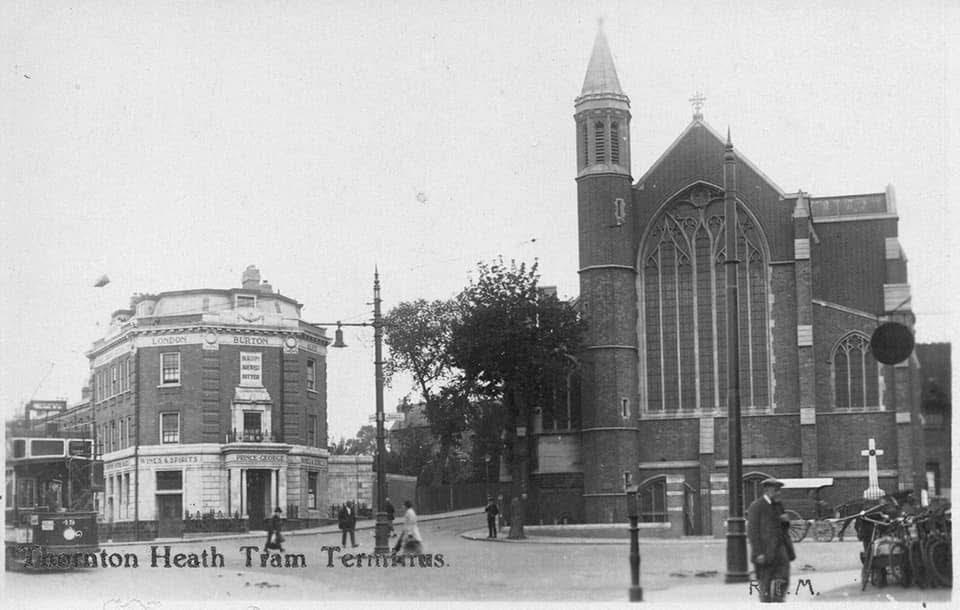
Between 1880 and 1889 plans went ahead for the new church to be dedicated to St. Alban, England’s Proto-Martyr and Primal Saint. The architect was local born William Bucknell, and the windows were under the supervision of Sir Ninian Comper. The church was to be Anglo- Catholic in its devotions.
The foundation stone was laid in April 1889, and six months later, the first portion of St. Alban’s had been built. Over four hundred worshippers could gather in the four bays of the nave; the walls up to the top of the arches now having been completed and covered with a temporary iron roof. The church was consecrated by the Bishop of Dover on St. Alban’s Day 1891 and by this time over 800 worshippers could be accommodated. St Alban’s was granted its own parish in 1921.
The original plans never came to fruition apart from the floor plan, and the church was built bit by bit and eventually ‘finished’ in 1939 with the completion of a permanent porch and narthex.
*extract from ‘Memories Grave and Gay’ by Canon William Fairbairn La Trobe Bateman
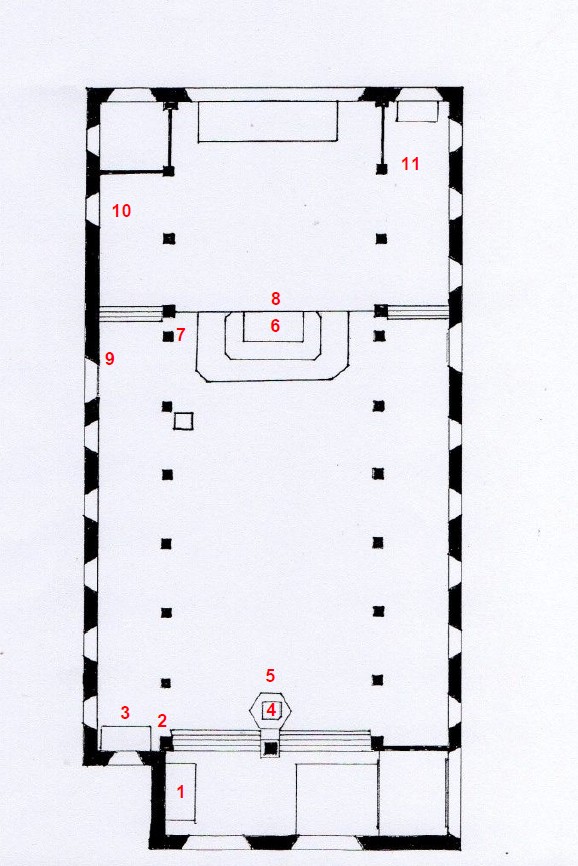
Church Floorplan
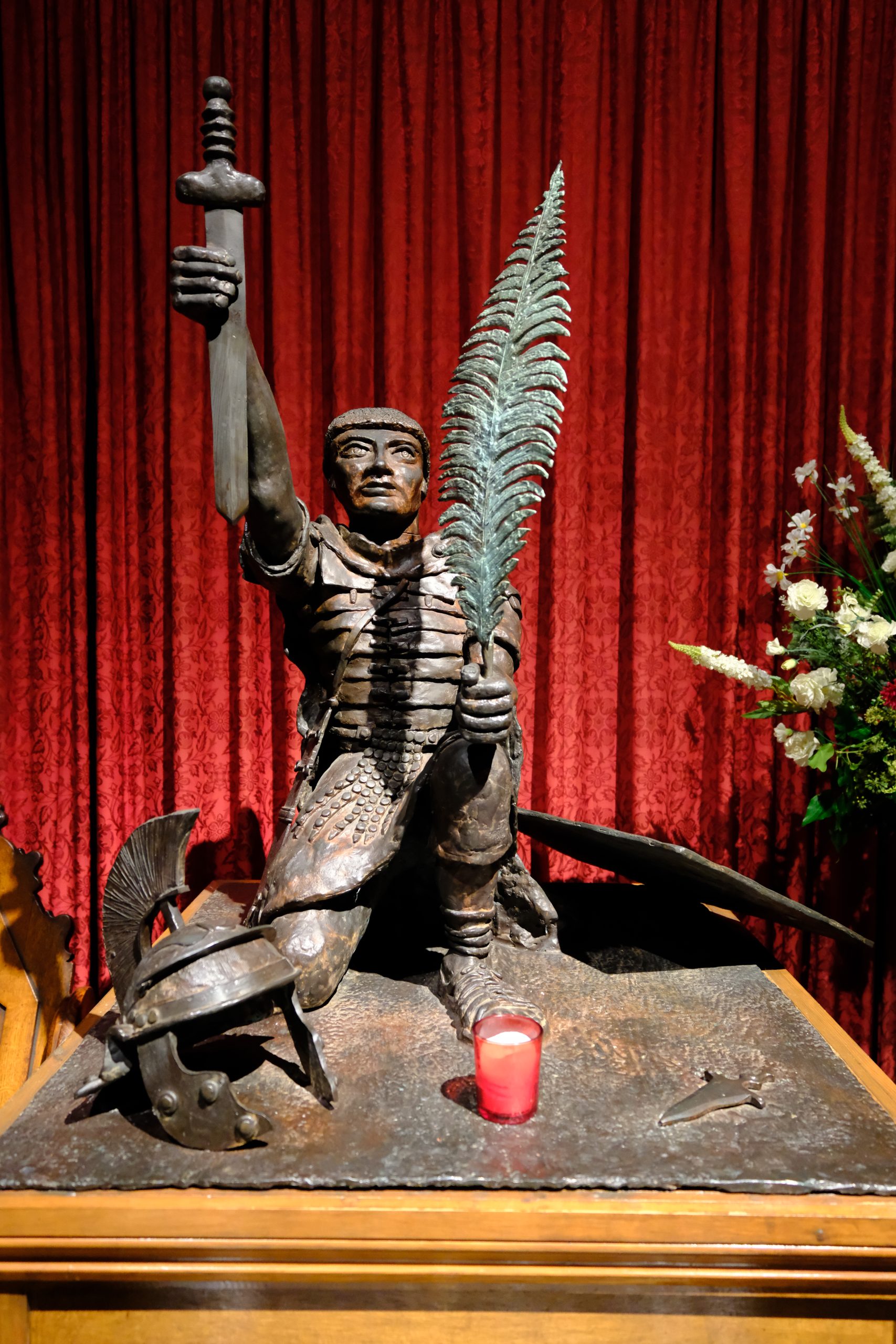
Statue in bronze of the church’s patron St. Alban designed by Leslie Glasgow. It shows St. Alban as a young soldier.
The foundation stone laid by Hilda Mary la Trobe Bateman, daughter of the Vicar of St. John’s, the mother church until 1921.
Children’s Chapel
The font which is sited on an octagonal base.
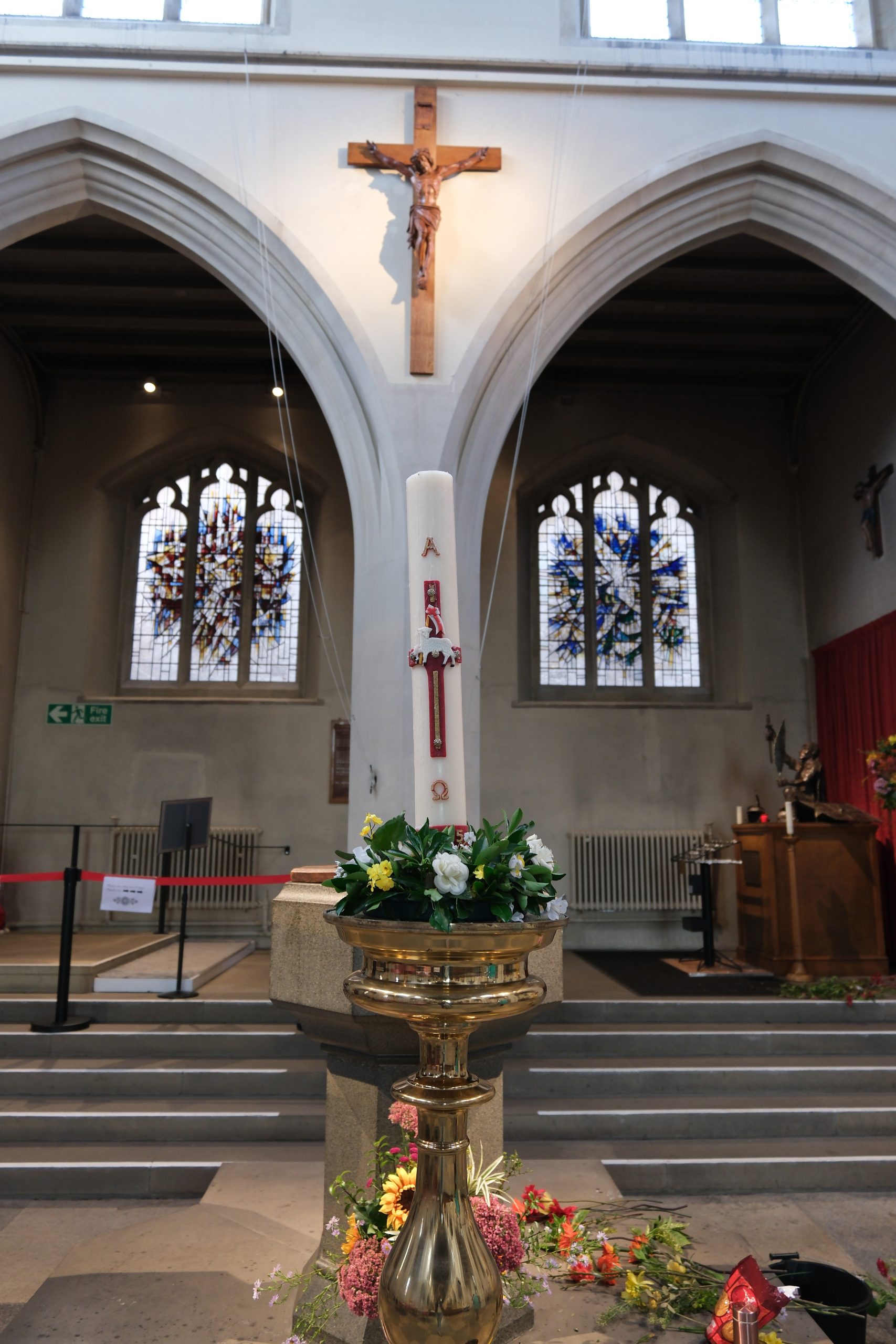
The Paschal candle stand which was a gift in memory of Mrs Hilda Potter in 1982. During Easter- tide this will be by the Nave Altar
During the 1990’s the use of nave Altars became more common place and the Nave Altar Platform was built in 2002 to accommodate both the altar and celebrant.
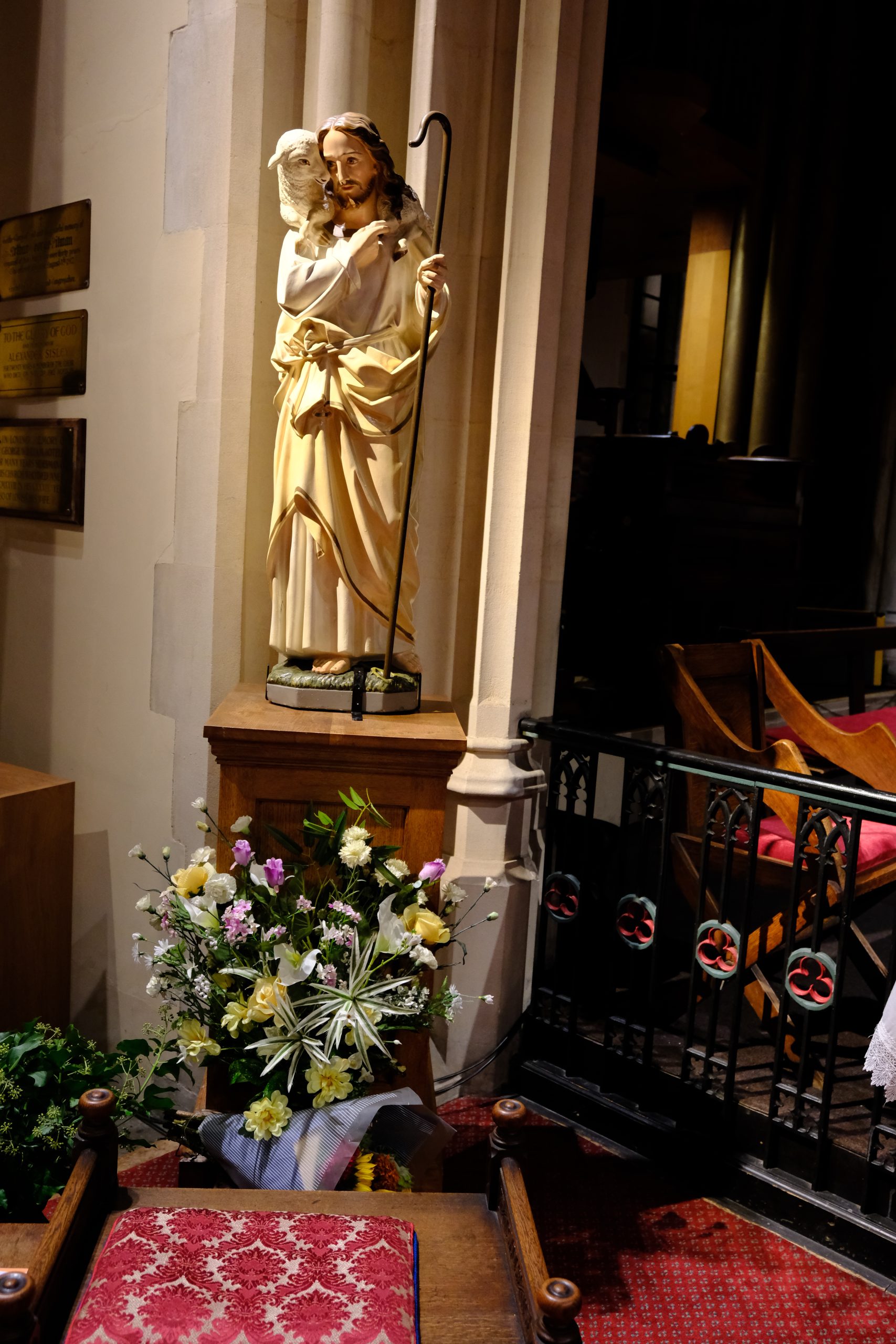
The Good Shepherd statue – the only statue to survive the move from the chapel in Ely Road. The 7 Sanctuary Lamps were initially installed in the Mission Church.
The Rood was given in memory in of Mr W. H. Thomas, a former churchwarden who died in 1952.
The Thurible Stand was given by Mr K. Treacher in 1984 to celebrate his 50 years as an Altar Server.
The Jesus Chapel aka His Holy Name Chapel
The Lady Chapel. In the oriel window. Fr. Bateman, the church’s founder is commemorated. The Aumbrey Light above the Tabernacle was given in memory of Mr. E. (Ted) Batchelor, Churchwarden 1960 – 1992.
The stained glass windows in the church – a short guide
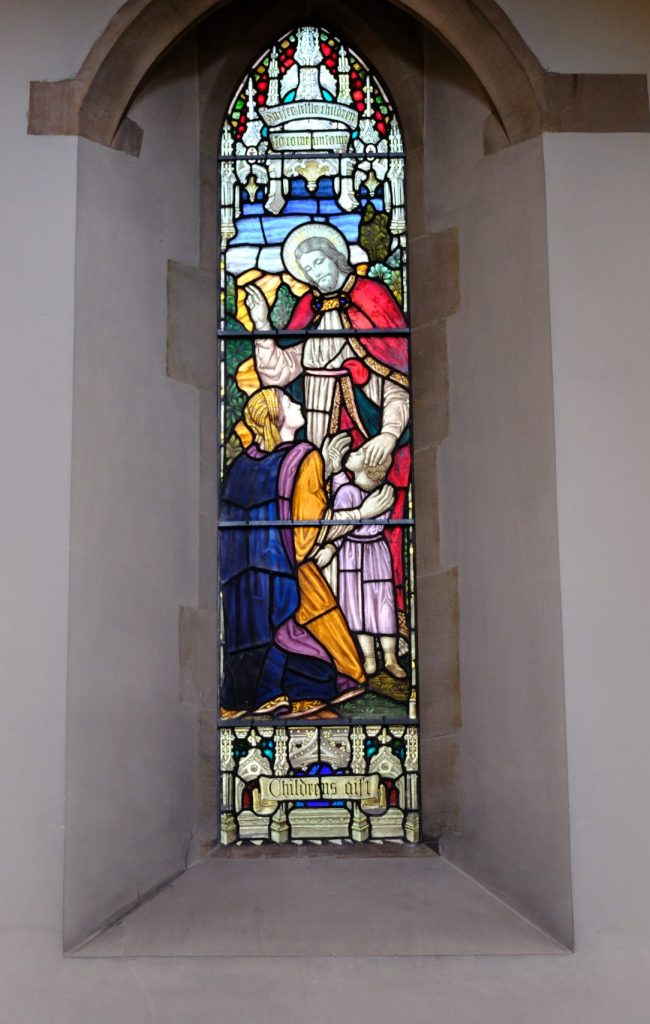
The children’s corner and window was installed in 1927 and Bishop Goldsmith presented dedicated the altar in 1929.
The inscription is
“Suffer little children to come under me”
This well known Biblical quote is found in the Gospels of Matthew, Mark, and Luke, and the phrase “suffer the little children” is a translation of an archaic term meaning “allow” or “do not hinder”. The full verse is typically rendered as: “Jesus said, Suffer little children, and forbid them not, to come unto me: for of such is the kingdom of heaven” (Matthew 19:14).
The colours are vivid which is indicative of the Gothic Style which consisted of vividly coloured glass
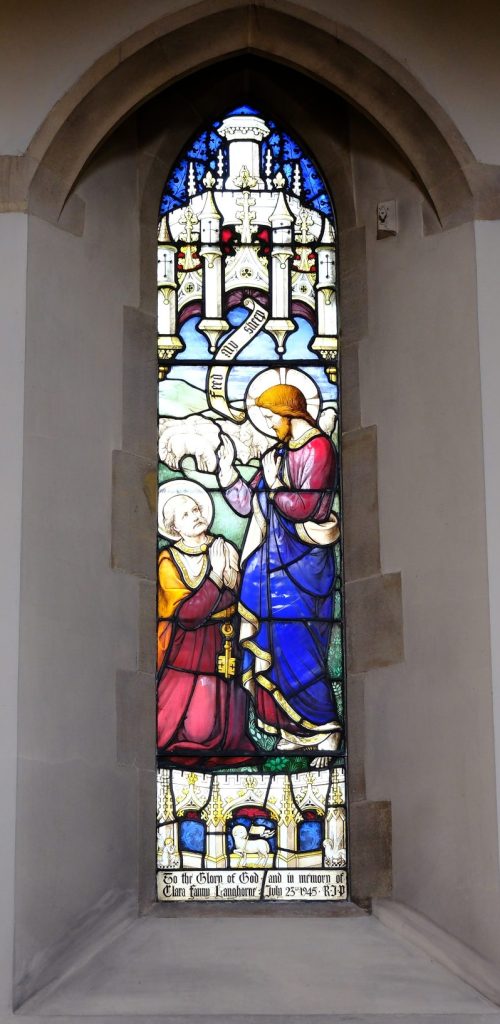
This window is dedicated to Clara Langhorn who died in 1945, a probable relative of St Alban’s third vicar, Rev’d E H Langhorn.
The illustration is of Jesus telling Peter to ‘Feed my sheep’; a possible reminder that the people’s faith needed to be nurtured following the 6 years of war.
At the foot of the illustration can be seen the symbol of the Lamb of God.
Here, the colours are slightly more translucent, a technique known as
opalescent glass.
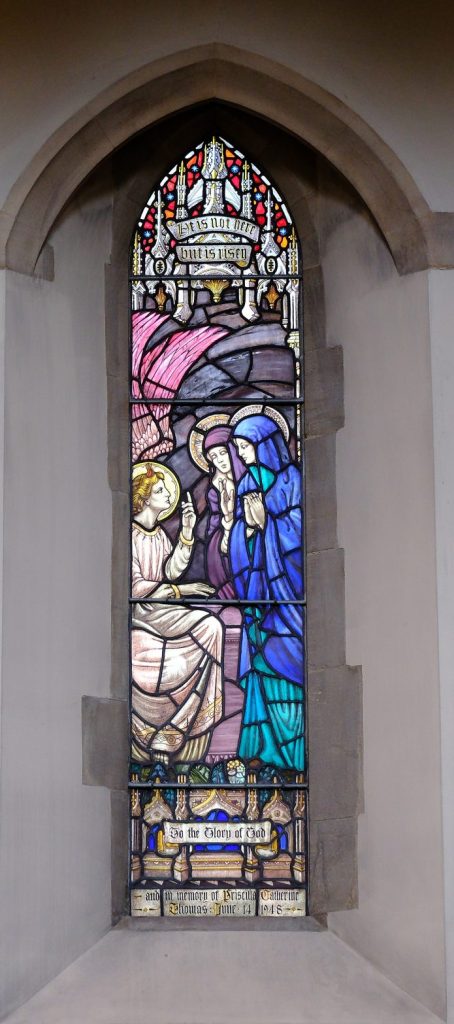
This window is full of hope and joy as the resurrection is celebrated. The angel tells Mary Magdalene and the other women,
“He is not here, but has risen.”
Current research has not found any information about Priscilla Thomas to whom the window is dedicated.
The style is similar to the one prior.
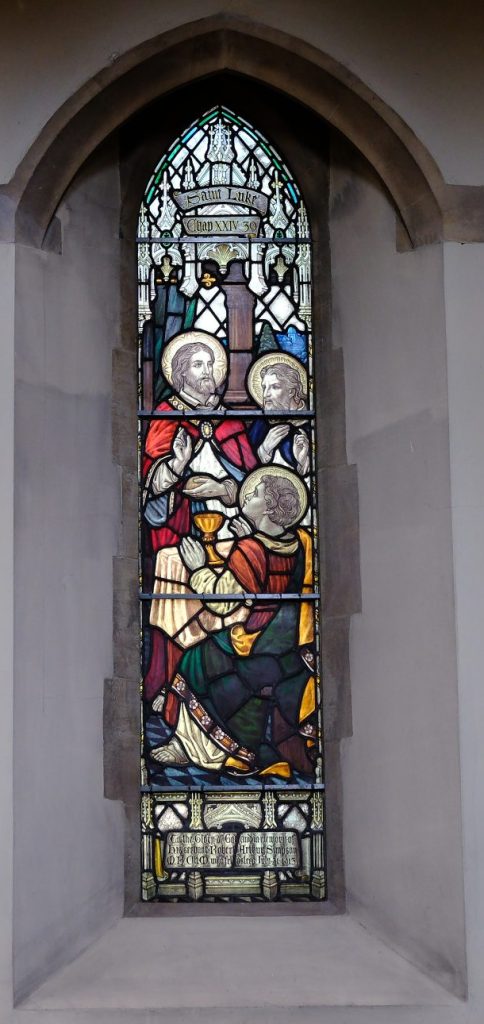
The Simpson memorial window celebrates
Jesus breaking bread with Cleopas and a companion on the road to Emmaus.
The scripture passage referenced in the picture is
“Now while he was with them at table, he took the bread and said the blessing; then he broke it and handed it to them.”
Jerusalem Bible
The Simpson family were very generous benefactors to the church. Dr Simpson was a Churchwarden. The window was installed in 1928.
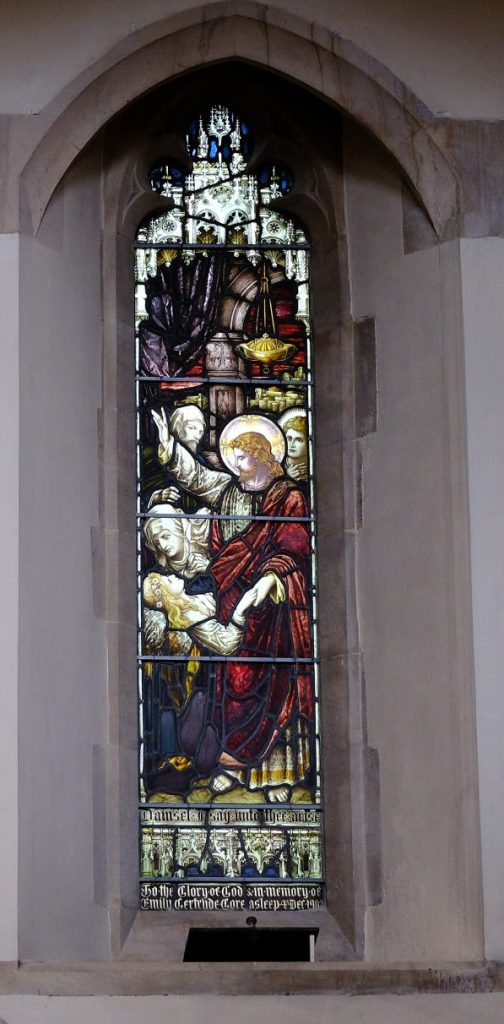
The story of Jairus’ daughter is shown in this memorial to Emily Gore.
The Gore family were also a prominent family within the church.
The inclusion of a thurible in the picture acknowledges that St Alban’s was built in the Anglo- Catholic Style following on from the Oxford movement where prayers for the dead were revived.
This revival included prayers for a soul’s purification in the afterlife, rather than for salvation or deliverance from hell, drawing on views of a purgatory-like state.
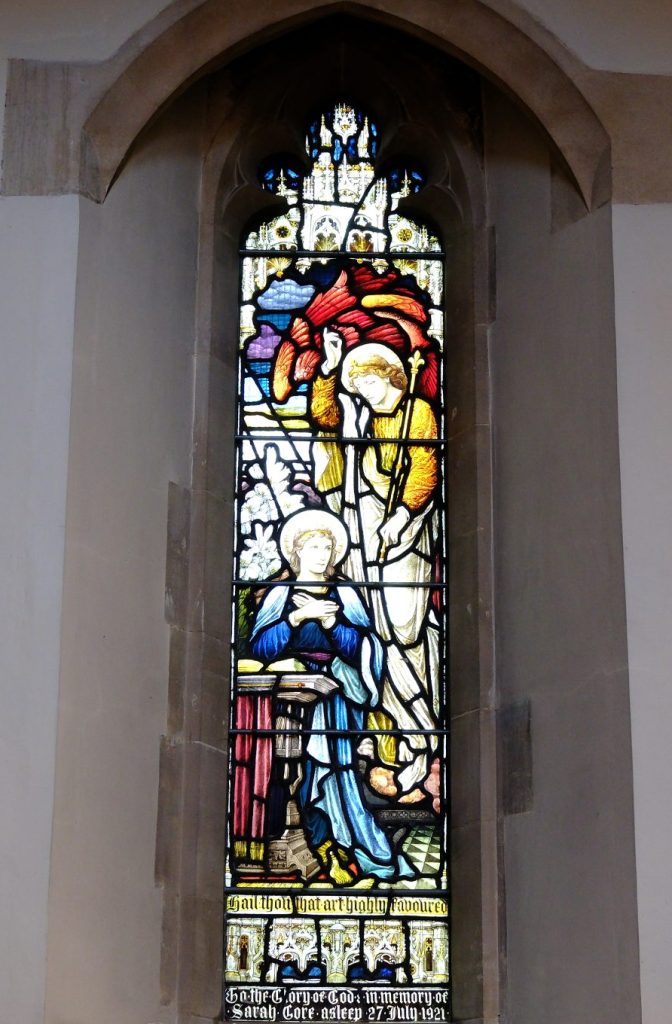
The Annunciation is used to commemorate another member of the Gore family; Sarah.
The last few windows are all of a similar style. As the church was now almost complete, families turned to decorating the church windows, just as Ninian Comper had hoped. It is likely that these windows would have been commissioned between the wars.
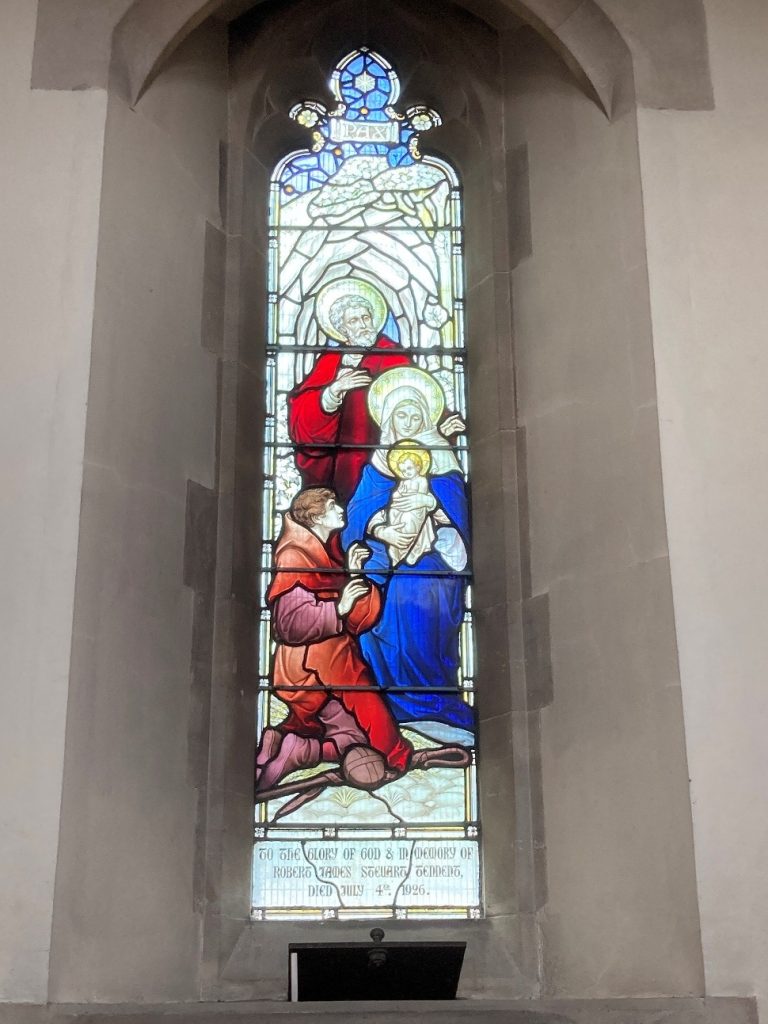
Robert James Steuart Tennant was a People’s Warden for many years.
Traditionally of the 2 Wardens, one would be chosen by the Vicar (known as the Vicar’s Warden); the other being elected by the people of the parish.
This is a simple scene, yet so full of meaning, a shepherd offering his heart and service to the Lord Jesus.
Here, the clothes worn by Joseph and Mary are more solid in colour than the
‘faded’ ones of the shepherd.
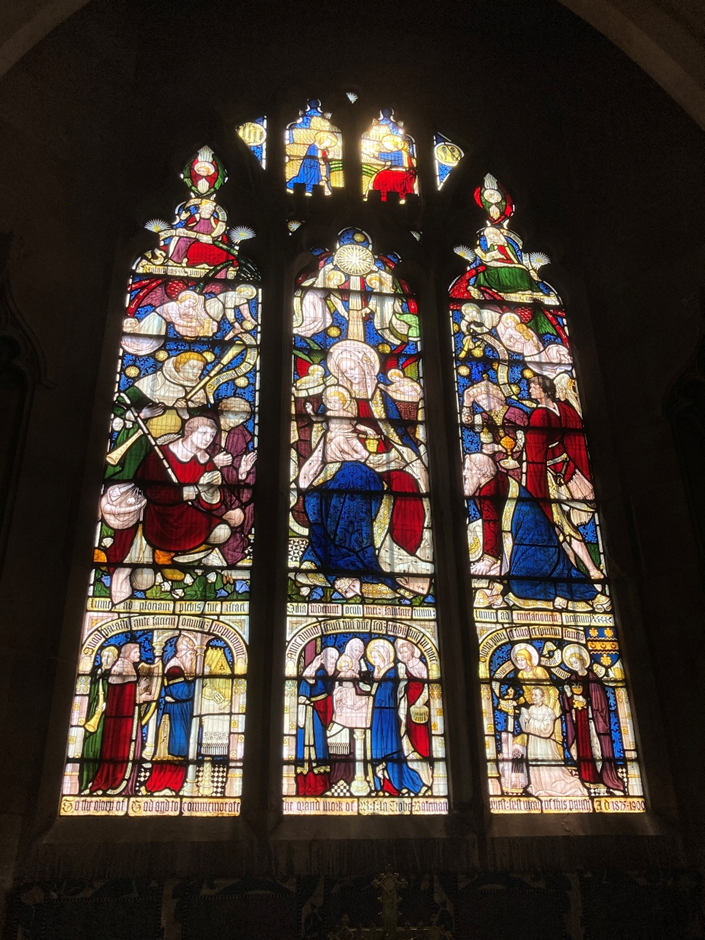
The window in the Lady Chapel was designed by Ninian Comper to commemorate the departure of the founder, Fr William la Trobe-Bateman to Ascot. He was by default the first vicar of this parish as St Alban’s was the daughter church of St John’s Church, Upper Norwood. St Alban’s was granted her own parish in 1921.
The main panel in the window celebrates the Nativity and Mary’s gown has the Comper ‘brocade’ as does one of the visitors from the East.
The window shows Mary’s parents, Anne and Joachim and in the lower panes, David entering the Temple, the Presentation and Fr La Trobe Bateman with St Alban and St John with St Alban’s in the background.
Sir Ninian Comper (1864-1960) is well-known for his stained glass, his use of colour, and his subtle integration of Classical and Gothic styles. From 1903 Comper “signed” his windows with a wild strawberry
It is said that the Lady Chapel altar vestments are made from the hangings that he designed for the coronation of George VI. All the churches in London were given a portion of the material to do with what they wished.
If you like a more detailed talk about the window, please let one of the stewards know.
Continue back down into the Nave and along the aisle to the next window in memory of Fr John Holdsworth, Vicar 1965-1983.
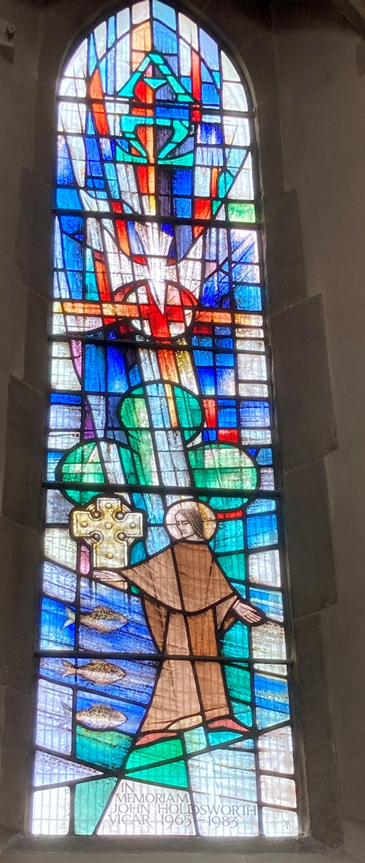
This is a set of 3 windows designed by Alan Younger that were dedicated in May 1993. The style is more modern as it incorporates the abstract and expressionist art movement influences.
This window is dominated by a burst of white light in the form of a dove surrounded by tongues of Fire for Pentecost. The shafts of light descend on St Patrick set against hills and water to suggest his journey to Ireland., the cross his missionary preaching and the organised church he brought into existence there. Behind the saint is a 3 leaved shamrock.
God the Father (Alpha & Omega), God the Son (the 3 fish) and God the Holy Spirit (the dove) can also be seen.
Fr John’s ashes are interred beneath.
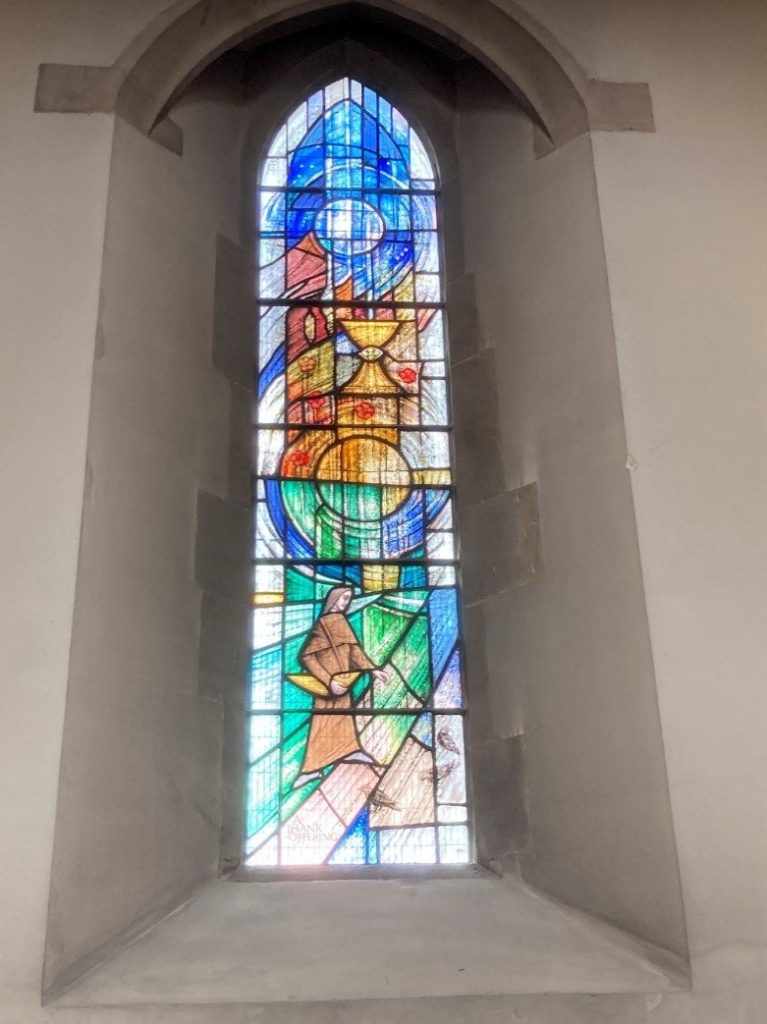
This window suggests the cycle of the 4 seasons as well as the Sun and moon cycle to symbolise Resurrection.
At the bottom we see the sower (Spring), in the middle Summer and Autumn are represented by the Eucharist (the sun) and the ripening corn (the Chalice); the 5 poppies being the 5 wounds and blood of Jesus. Winter is portrayed by the moon, stars and snowflakes.
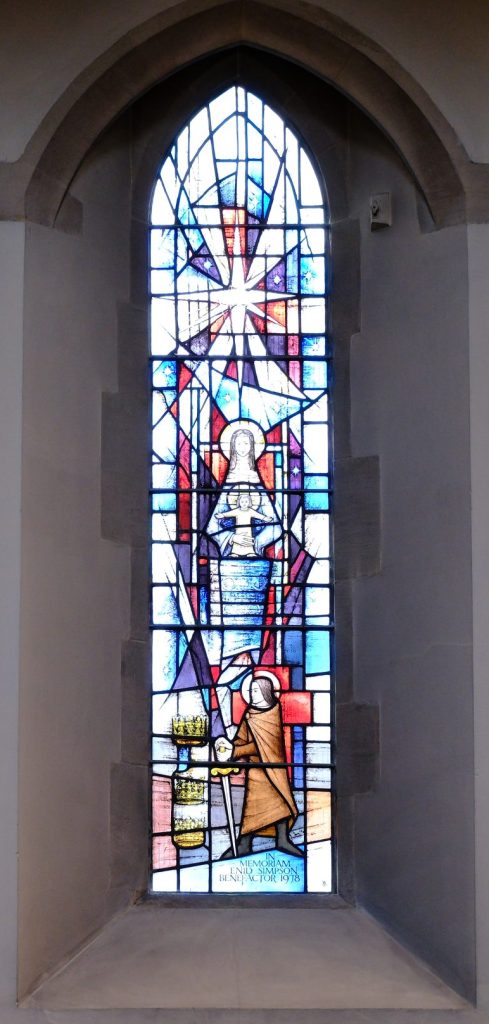
Another memorial to a member of the Simpson family. The family left a large legacy that was finally spent in 2011-12 when the aisle roofs needed to be re-slated.
This window celebrates the birth our Lord. The Virgin is crowned with 12 stars as in Revelation.
The proto martyr, St Alban, is shown in the base of the window at the moment when he hands over his sword set against a cross to symbolise his sacrifice. The 3 crowns are thought to refer to the three kings and their gifts.
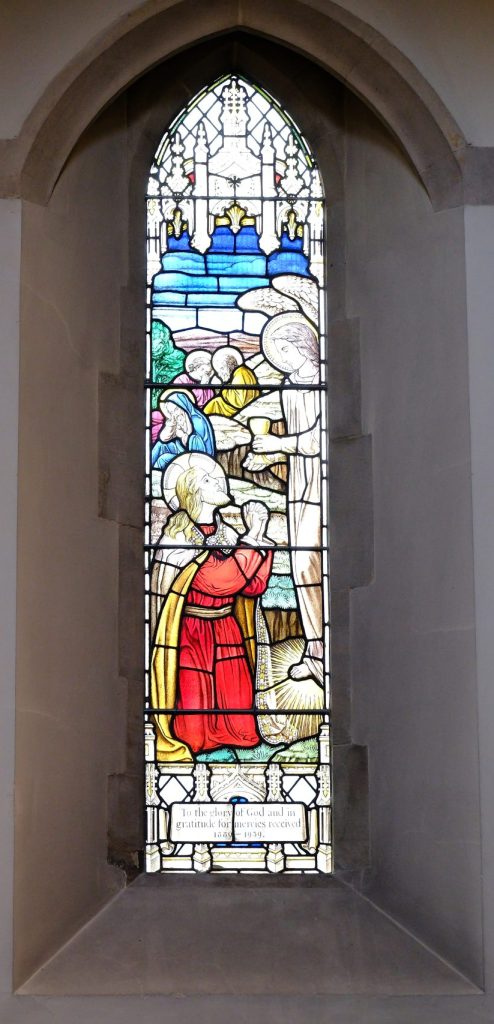
The Agony in the Garden is one of the earlier windows and the style reverts back to those at the beginning of the tour. We do not know to whom this window is dedicated. However, records show that is was vandalised in the 1990’s and restored by Alan Younger.
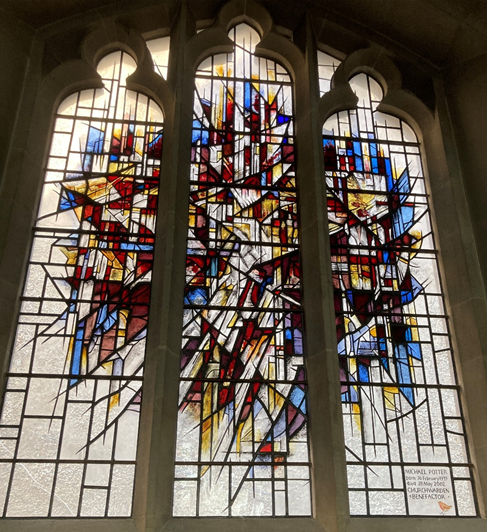
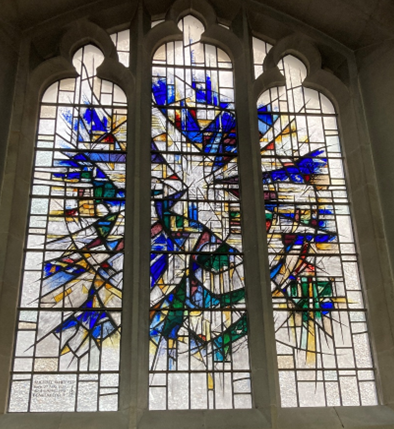
The 2 windows in the Narthex are the latest additions, designed again by Alan Younger but finished and installed by his colleague, Carolyn Benyon.
The windows are dedicated to two Michael’s, one time Churchwarden and Treasurer, the other a faithful steward during services. Their substantial legacies allowed the church to be completely redecorated and a new lighting system installed (since replaced by LED lights) in 2003.
The dedications show their hobbies; Michael Potter was a keen ornithologist and Michael Whitfield, a connoisseur of classical music.
These are very modern in design and deliberately so to “provide scope for individual interpretation” (Alan Younger).
The window in memory of Michael Potter with its predominantly ruby colouring, the cross on an antique glass alongside the jagged shapes may be seen broadly to symbolise suffering and sacrifice, Christian martyrdom and in particular St Alban.
In contrast, the blues and greens of the window dedicated to Michael Whitfield with the central star and dove like burst of energy and light might be seen to represent the Resurrection, re-birth and creation.
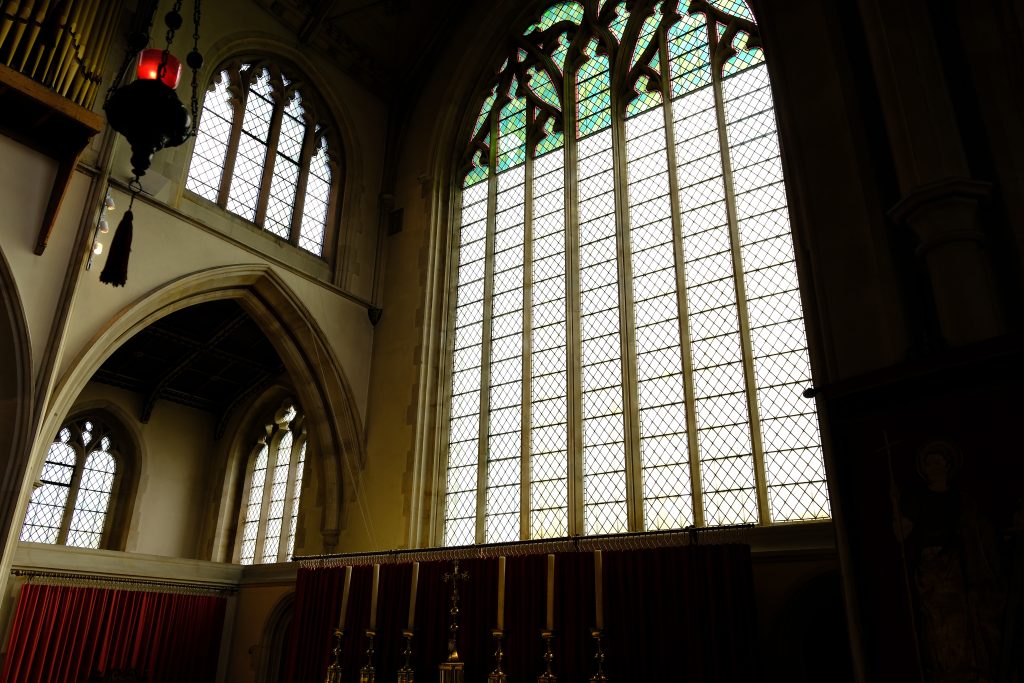
The East Window.
This window we believe was filled with green painted glass with a red border.
During World War Two, the window was boarded up with sheets of asbestos. Upon removal the vast majority of the glass fell out. Flying bombs and V2’s had landed in the area during 1944.
What glass could be salvaged was re-sited in the top part of the window, the rest was discarded and plain glass put in. A pink curtain was hung to stop the glare of the sun coming in but this was taken down and now the congregation bask in the sunlight that makes itself known on a Sunday morning whilst the Eucharist is celebrated.